


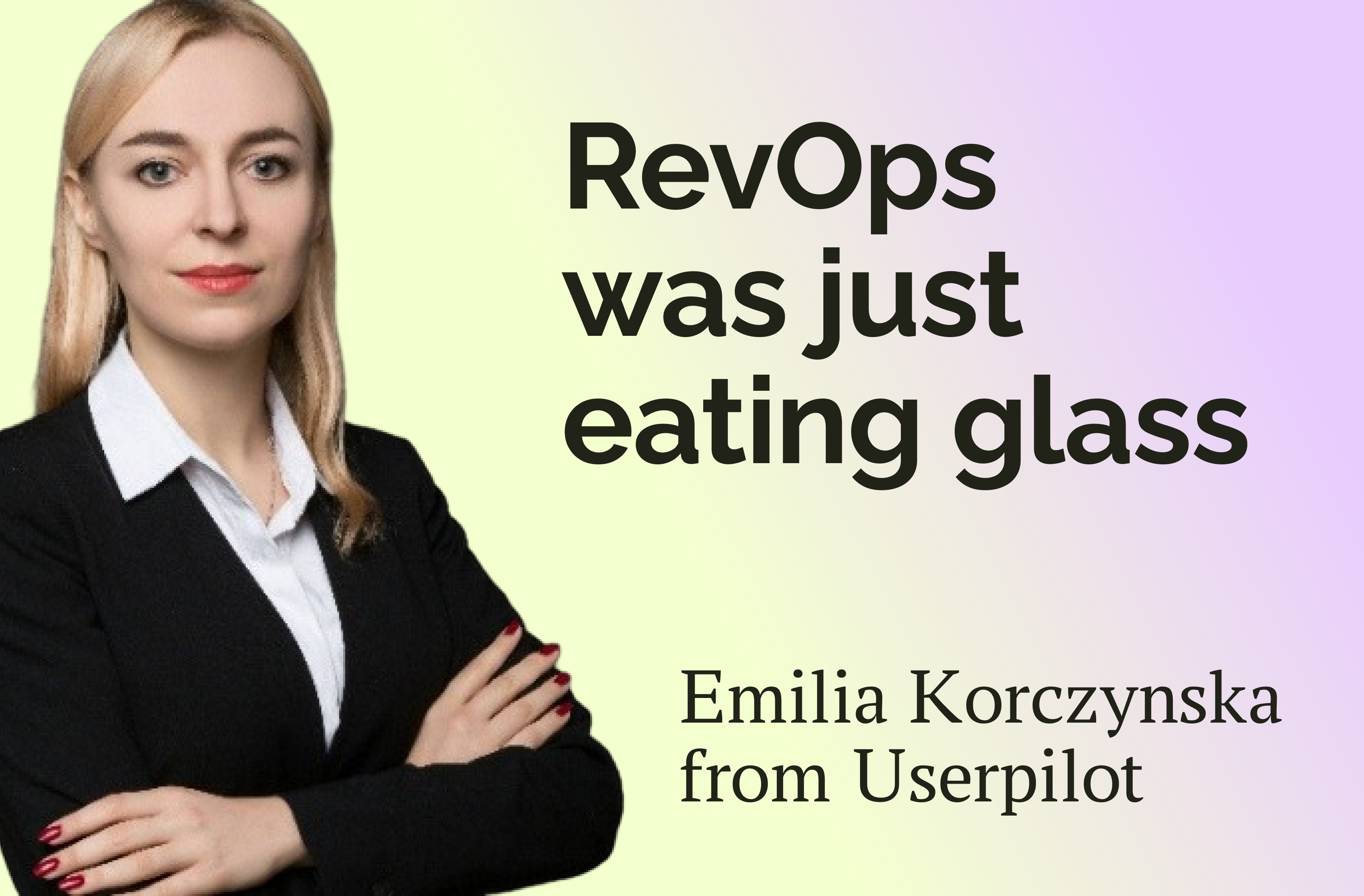
Userpilot grew almost entirely on organic content. In May 2024, with the blog at its peak, Emilia Korczynska started rebuilding how the company finds customers, and the trigger was a falling conversion rate while traffic was still climbing: as Userpilot moved upmarket, organic search kept delivering companies that could not afford the new pricing. The rebuild ran on LinkedIn ABM, took three months of research before a single campaign went live, and the deals it opens are considerably larger than inbound ever produced.
About Userpilot
Company: Userpilot, founded in 2019. A scale-up selling mostly into the US, with customers ranging from Raiffeisen Bank, DHL and Adobe down to seed-stage SaaS startups.
Product: A product-growth platform covering onboarding, in-app engagement, product analytics and user feedback, used by product teams to drive adoption without shipping code.
Stage: established scale-up.
Marketing team: In-house, covering content, ABM performance, Google Ads and product marketing. Head of SEO, head of demand gen and a GTM engineer were all open seats at the time of recording.
The article focuses on expertise of Emilia Korczynska, VP of Marketing at Userpilot, author of Content Operations, and co-creator of ZenABM, the LinkedIn account-scoring tool her husband built after she could not find one that did what she needed.
A working channel can stop fitting the business
May 2024 changed how Userpilot acquires customers, and nothing in that month's traffic report showed it. The blog was at its peak, and by then the company had raised its prices and gone after larger accounts, which organic search could not deliver.
Emilia Korczynska, VP of Marketing at Userpilot, built that content engine and then made the call to stop relying on it.
"I wouldn't say it's necessarily wrong or breaking. It's just that it wasn't enough anymore, as we were growing as a company and going upmarket and targeting larger and larger companies."
Two things were happening at once, and only one of them was the SEO story everybody tells.
"We didn't control the size of the companies that were searching for particular keywords, so it was completely random."
You cannot choose who searches. Any company that types the keyword arrives, and once Userpilot raised its prices, a good share of those arrivals could not afford the product. Conversion rates from organic fell while the traffic line kept going up, which is what makes this hard to catch in time. Nothing in the dashboard said stop.
What she wanted instead was predictability. Forecasting on organic came down to one hope:
"Keep our fingers crossed that this month, enough of these larger prospects will be searching for specific keywords."
The second reason was the familiar one. AI Overviews rolled out, Google shipped algorithm updates, and blog traffic started falling away from its peak. Conversions held up better, because a handful of bottom-of-funnel posts carry most of the revenue. That gap bought her time, and it framed the question she rebuilt around: what happens when conversions catch up with traffic.
The organic collapse arrived 20 months after Emilia stopped betting on it
Emilia started rebuilding acquisition in May 2024. The crash she was bracing for held off until January 2026, and by the time it landed Userpilot had a second channel producing pipeline.
The public record backs her timing. Ahrefs, which counts search visits only, has organic traffic to userpilot.com falling by roughly four fifths between January and April 2026.
So Emilia acted on a falling conversion rate while traffic was still rising and nothing in the reporting told her to. A team that waited for the crash as its evidence would have been starting three months of research in February 2026, with the pipeline already draining.
Three months of research, and two hires instead of one
Userpilot decided to go after large accounts directly, through account-based marketing, and nobody on the marketing team had ever run a program like that. Getting from the decision to a live campaign took three months of research and two new hires.
The idea came from the CEO, who sits far enough from the daily work to see the whole shape of the business. Emilia then spent three months reading and comparing approaches: "it took me around three months to put all my ducks in the row."
Hiring was the harder part. She looked for someone who could both design account-based campaigns and run them through performance channels, did not find that person, and stopped looking.
"It's really hard to find a person that has the skill set to do both. So we decided to hire two. And we did."
One LinkedIn performance manager with real ABM ad experience, one strategist for the campaign design. Emilia picked LinkedIn over display advertising because her experience with the Google Display Network had been bad, and she says it still is. Two and a half months after launch the first deals arrived from accounts that had never touched Userpilot before, and at 90 days the pipeline it had opened was already into six figures.
From the decision to the first real result was five to six months. Promise a board pipeline any sooner than that and you will be explaining yourself in month three.
What separates ABM from running LinkedIn ads
Plenty of teams believe they are running ABM when they are running LinkedIn ads. Userpilot was one of them for a while, and Emilia counts those earlier attempts as failures.
"We literally had these feeble attempts at what we thought was ABM. It wasn't ABM. We were just running a few LinkedIn ads."
That earlier version ran a token monthly budget on book-a-demo display ads with loose targeting.
"So of course, it had to fail."
That test said nothing about LinkedIn, and it is exactly the kind of test companies use to write the channel off for years.
The real difference comes before any tactic is chosen.
"The primary thing is that you select a list of specific accounts that you want to target and that you want to acquire as customers. And then you think of ways how you can reach them."
Channels come second. The same LinkedIn ad account can run a pure inbound play or an account-based one, and what settles it is whether a named list exists.
ABM programs get described by how many accounts a single campaign speaks to. One-to-many runs one campaign against a large list, thousands of accounts, with the message written for a segment rather than a company. One-to-few narrows to a cluster of accounts that share a situation and writes for that situation. One-to-one builds everything around a single named account, down to bespoke landing pages and gifting. The cost per account differs by orders of magnitude across the three, and that is what decides which one a company can actually run.
Userpilot starts one-to-many. ZenABM then scores those accounts on how much they engaged and, more usefully, on which ads they engaged with, which is what shapes the follow-up. An account that read the onboarding content and ignored the analytics content gets invited to an onboarding event, and clusters of similar companies move into a one-to-few campaign written for their situation.
Why the target list has to run into the tens of thousands
Emilia ran a study with her husband across ZenABM's user base, on a question she had not seen answered anywhere: out of all the accounts you target in a one-to-many LinkedIn campaign, how many actually open a deal.
The answer came back at 0.58%, and that rate is what sets the size of the list.
"If you're trying to convert a list of one thousand accounts then you can count on what? Three deals from that, roughly. So you need to really reach a lot of companies."
Userpilot's own list runs into the tens of thousands. The same arithmetic is why one-to-one is off the table for them. Running gifting and bespoke campaigns against a hundred named accounts is a bet that you will beat the average conversion rate by 10x or more, and even winning that bet converts a handful of accounts.
"The value of these contracts needs to be so much higher to justify the effort. We just weren't there."
Over-engineering the funnel is the thing Emilia would take back. Kyle Poyar's post on ABX was what made ABM click for her, and she then built a separate campaign layer for every awareness stage in it. That does not work on LinkedIn, which will not serve ads to an audience under 300 members, so narrow retargeting pools take months to fill.
"Don't over-engineer things."
She also gave up on scoring accounts precisely.
"It's very hard to operationalize interest, so it's all very directional. You can't expect that if someone clicked five times they are definitely already ready to buy versus someone that clicked three times."
Last-touch attribution misses around 90% of what LinkedIn influenced
Even a well-run program reads as a failure under last-touch attribution, which is still how most teams measure. The line Emilia quotes on this she picked up from a LinkedIn post, and she credits it every time.
"Last touch attribution is like saying the reason why I got home today was the door."
Someone clicks a branded Google ad and converts, and last-touch hands Google the credit, even though that branded search only happened because the person already knew the brand. For LinkedIn specifically, Emilia puts the unrecorded share at around 90% of the conversions the channel influenced.
So Userpilot measures correlation instead. They check whether LinkedIn ads reached a target account inside a fixed window, then whether a deal opened there. The window is 180 days.
"It might seem like a long window, and it probably is. We could be stricter with the attribution, but because this is where we started from, we're keeping it consistent."
Keeping it consistent beats getting it precise, because changing the measurement mid-program costs you the comparison. Accounts carrying touch points from organic, Google Ads and LinkedIn at once are genuinely hard to tease apart, and the ones showing LinkedIn engagement and nothing else are where the case rests.
The metric she stopped tracking altogether is leads.
"Downloading an e-book is not a buying signal."
Thought leader ads on personal profiles beat the company's own ad formats
Starting ABM did not cost Userpilot its content team. SEO kept running as its own channel, ABM ran alongside it, and some existing blog posts got reused inside the campaigns. Inbound still brings in serious revenue, though it is no longer the biggest source.
What did change is where that content has to win. The team now optimises for AI engines as well as traditional search, and those two objectives pull against each other. Google appears to penalise excessive self-promotional listicles, and listicles are exactly what earns mentions inside AI answers, so the same page has to serve both with no clean resolution yet.
The format doing the most work is the thought leader ad. The marketing team writes posts, individual team members publish them on their personal profiles, and the posts are then promoted as ads. They look almost organic apart from the sponsored line, and they outperform image ads and carousels on both volume and quality of engagement.
That required an argument internally.
"Even our CEO thought, "oh, but you're promoting personal profiles and their thoughts and not the company". But that's the whole point."
The reasoning that won it: a post making a coherent case for why your product solves a specific problem, sent to accounts you know have that problem, is content marketing working as intended. Userpilot tested posts from customers, from its own staff and from influencers, and influencers won on effective CTR by a distance, because credibility is what makes someone stop scrolling.
When ABM makes sense, and when the problem is not marketing
There is no deal size above which ABM starts working, and Emilia is specific about what actually decides it.
The stereotype is that it needs a very high ACV. At $1,000 ACV with a tiny addressable market and long sales cycles you are in trouble, and her diagnosis goes past marketing entirely.
"But it's not a marketing problem, it's a business problem. You need to pivot. You need to think of a different monetization model altogether."
Lower ACV can still work if your niche has cheap CPMs on LinkedIn, or if the product is close to mandatory once someone knows it exists. Her answer is to do the sum yourself: what it costs to reach your accounts, how many of them there are, and whether the return covers the effort. "Use your brain, use your common sense."
What AI does on Emilia's team, and what it failed at for a year
Userpilot uses AI heavily, and Emilia has deliberately stopped short of automating the marketing organisation end to end. Building that would take enormous effort, and she expects the outputs would be mediocre anyway.
Landing pages are the clear win. The team has enough accumulated context that she can invoke a skill, have it build a page on their existing framework, and push it live in minutes. Blog content works too, with one condition attached.
"If you want the content to provide incremental gains in terms of value then you need to give it something original each time."
The angle for a specific piece still has to come from a person. Cold outreach is where the automation failed outright, and the bill was a year of one engineer's time.
"Our GTM engineer spent a year building this process, and it still failed."
BDRs fail at cold outreach constantly too, which she points out herself. "At least it failed cheaper." Outreach gives you one shot at one line, and there are too many variables to get right: the moment, and the thing that matters most to that person right then.
"You still can't automate the inputs."
What to take from this
- A channel can stop fitting the business while its numbers still look healthy. Userpilot's organic conversion rate fell as ACV rose, and traffic kept climbing for another year after the rebuild started.
- Budget five to six months before an ABM program produces anything: three months of research and hiring, then about ten weeks to the first deals.
- One-to-many ABM opens deals in roughly 0.58% of the accounts it targets. That rate is what forces a target list into the tens of thousands, and what makes one-to-one unaffordable below a very high ACV.
- Last-touch reporting can hide around 90% of what LinkedIn influenced, so a consistent correlation window beats precise measurement of the wrong thing.
- Below a certain ACV, ABM is not the decision in front of you. A $1,000 contract with long sales cycles is a monetization problem, and marketing cannot fix it.
The rebuild worked, and the part worth copying is the timing more than the tactic. Emilia acted on a falling conversion rate while every headline number was still going up, and the twenty months that bought her were exactly what the channel had left.
This article is adapted from an episode of Rebuilding SaaS Marketing by Digital Hunch, where Emilia Korczynska, VP of Marketing at Userpilot, walks through what she rebuilt when the content engine she wrote the book on stopped matching the business.
Watch on YouTube and listen on Apple Podcasts and Spotify.
