


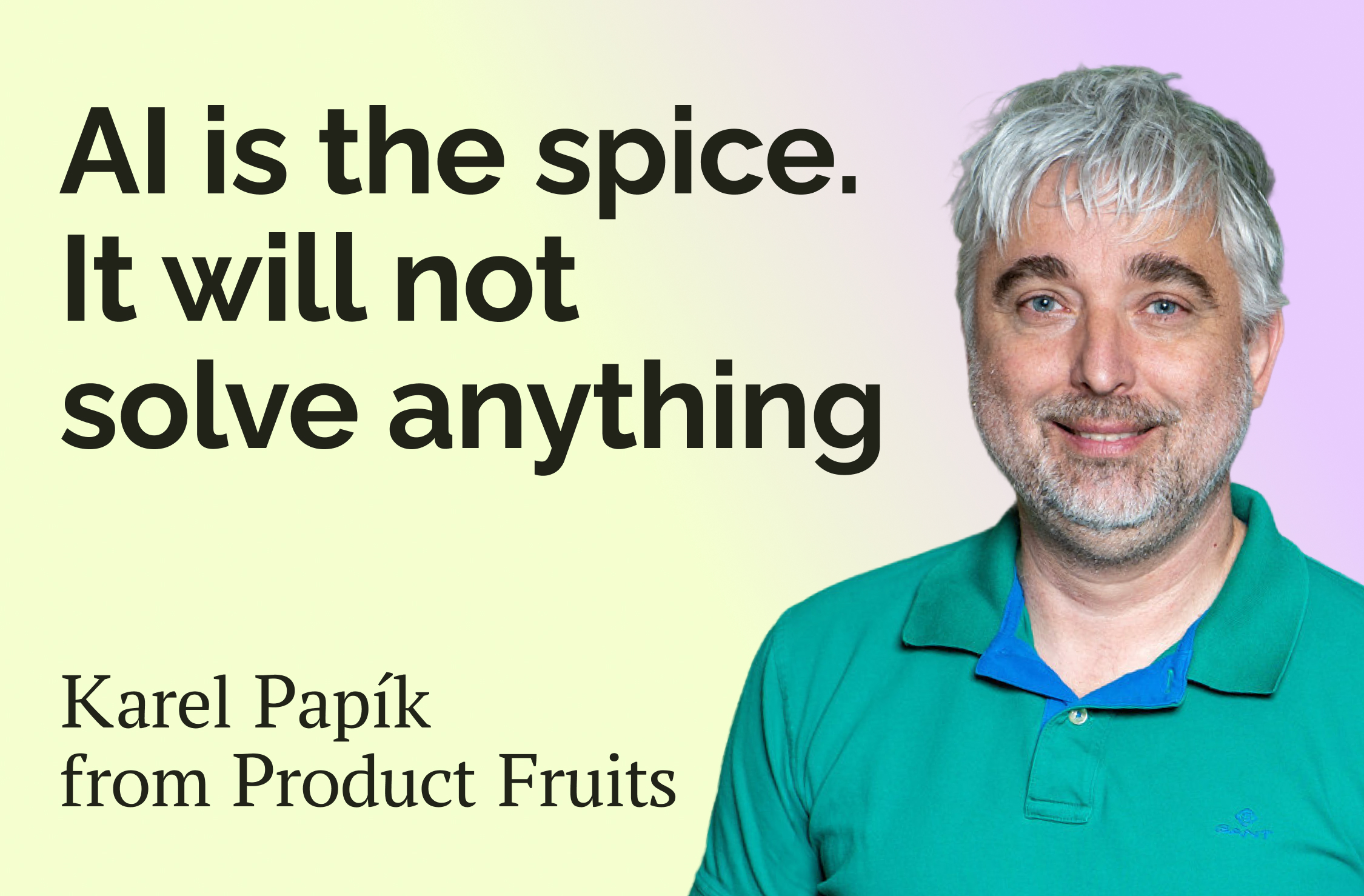
Product Fruits reached roughly $2M ARR on paid search and self-serve signups, running no SEO and no outbound. Then both engines failed. The company moved to sales-led growth, disbanded its customer success department, and discovered that its largest revenue leak sat downstream of signup: more than half of its leads disappear on day one.
About Product Fruits
Company: Product Fruits, founded in Prague in 2020. Used by more than 1,300 paying companies across 60+ countries, with the United States as its largest market.
Product: A product experience platform that sits as an independent layer between an application and the people using it, covering onboarding, adoption, in-app support and churn prevention. Its AI assistant, Elvin, runs a discovery conversation with each new user and shapes the onboarding around the answers.
Stage: $3.5M raised across three rounds. 25 people between Prague and Pilsen.
Marketing team: One person, handling landing pages, campaigns and everything else.
The expertise here belongs to Karel Papik, co-founder, who runs sales, marketing and investor relations as the public face of the company after fifteen years and sixteen titles in video games. Product Fruits competes against Pendo and WalkMe, both far larger.
Why Product Fruits ran no SEO for its first two years
At 25 people, every channel decision is really a decision about what you will not do.
"Our decision was not to do SEO, because we saw that our competitors employ teams of 15, sometimes 30 people doing content."
What they did instead has a name inside the company, and it is a blunt one.
"We will let other people educate the market and then we are harvesting them."
Competitors spend the money that teaches the market what a digital adoption platform is and why anyone would buy one. Product Fruits waits at the end of that education and collects the people who arrive already convinced. For scale: 15 to 30 people writing content at the competitors he was watching, against one person doing all of marketing at Product Fruits.
Worth adding what the public data shows, because Product Fruits does run SEO now. We pulled the history in Ahrefs. Organic traffic to productfruits.com sat under 50 visits a month through all of 2022, while paid peaked above 4,000. Organic passed paid for the first time in March 2023 and kept compounding, reaching roughly 6,800 visits in February 2026, a month when paid was down to about 650. Their blog now holds position one for terms like "product tour software" and "b2b saas onboarding".
So the real decision was about timing. Karel's line about letting other people educate the market still describes how they won early, though it stopped describing where their traffic comes from somewhere around 2023.
The bill for the original choice arrived in the next channel over.
Where paid search stops scaling
Paid search carried the company early. It has an edge that more budget does not move.
"PPC had a ceiling. Only a certain number of people are searching for that string."
Marketing plans rarely account for this. Spend and pipeline get modelled as though demand scales with investment, when demand for a search term is fixed in any given month. Once you show up for all of it, the next dollar buys a worse position on the same pool. A team that harvests rather than educates inherits exactly the demand that already exists.
From product-led to sales-led growth
The second failure was the strange one, because the product caused it by getting better.
The signal showed up in the free trial. Conversion started sliding and the first explanations were the usual suspects, a new competitor or someone cheaper. Neither held up. When the team lined the declines up against their own release dates, the pattern was uncomfortable.
"Every time we added a big new tool, we saw a decline in adoption."
Self-serve depends on a user finding out what the product does without anyone helping them. Every release widened the distance between what the platform could do and what a trial user could discover alone. The team was shipping its way out of its own growth model.
"PLG stopped working. So we switched to sales-driven. 100% inbound only."
Sales-led growth, in this case, is narrower than the phrase usually implies, with no outbound and no cold sequencing anywhere in it. The same inbound signups keep arriving, and now a human meets them on the way in.
The cost of that switch shows up in the trial. At any given moment more than 300 companies are inside one. That used to convert at around 22%, back when the product was simple enough to sell itself. Today the trials that convert are the ones where a salesperson or an implementation engineer got involved, which is a considerably more expensive way to earn the same customer.
What didn't work: ABM and the affiliate program
Karel's job title for the man who runs all of Product Fruits marketing tells you the operating conditions.
"I'm not calling him chief marketing officer. I'm calling him a plumber. He is just fixing the leaks and we have them everywhere."
Account-based marketing never landed, and the target list was never the problem. What they could not find was anyone who would build the motion instead of running workshops about it, which is where Karel reaches for a line he attributes to Steve Jobs.
"Agency people sell you bananas. They know how a banana should look, they can describe it, but they never tasted it."
The affiliate program stings more, because it was the bet he felt surest about.
"We started it, we did everything, we have some platform well known, and it got pure zero."
Zero is a strange result to get from an audience this warm. Product Fruits has 1,300 paying companies, and close to 400 people signed up for a single webinar. Those customers recommend the product to other companies all the time. They will not do it through a program that pays them, and Karel has no theory for why.
More than half of leads disappear on day one
Product Fruits sells onboarding software, which means it measures what happens after signup more closely than most companies measure anything.
"Even for us, definitely more than 50% of leads disappear on day one."
Ninety seconds is the typical lifespan. Someone reads an article, clicks the link, opens the application, and is gone before it has finished loading. Karel has been looking at this number for years and still finds it baffling. Product Fruits sells software built for exactly this moment, and half its own leads leave before that software can do anything.
"A lot of founders are focused on lead gen and signing up for the product, and they presume that this is it. And then they lose 90% of opportunities."
Every channel decision above this one, the SEO refusal, the paid search ceiling, the collapse of self-serve, sits upstream of a leak that dwarfs all of them. The work that closes it has no obvious owner either. Marketing hands off at signup, sales picks up at the qualified lead, and the space in between belongs to nobody. Karel calls adoption "kind of a Cinderella".
The limits of fixing this with a demo
The standard response to weak trial conversion is to put a salesperson in front of it. Karel describes why that usually fails, from the buyer's side.
"You listen to this monotonous speech of some poor guy who's doing it for the 10th time that day."
Three days later you open the product and cannot remember how any of it works, so you email him and he explains it again. A week after that you are stuck once more, and by now the social cost of asking has gone up.
"You're embarrassed to ask again, so you pretend to understand and then silently churn."
Nobody in that story files a complaint or answers a survey. The account goes quiet, surfaces in a retention number a quarter later, and by then the cause is unrecoverable. Karel puts it more briefly: "If I give you a car and you don't know how to ride it, you'll just turn on the radio for a few seconds and leave."
Replacing customer success with implementation engineers
Most SaaS companies answer this problem by hiring customer success managers. Product Fruits had a department and got rid of it.
"I didn't see big value for the customer really. It was just a sales push. So we disbanded that department entirely."
What replaced it was implementation engineers with deep product knowledge. Sales talks to a prospect about the use case, and anything complicated routes to someone whose job is making the thing work instead of expanding the account.
"Our customers are not afraid to talk to these people because they are not trying to sell them anything. They are just helping."
Customers started talking more openly once nobody was trying to sell to them.
Underneath the humans sits the AI layer. Almost 90% of technical questions are answered by Elvin, which leaves the support team on the genuinely hard ones. Karel's argument for that split is economic before it is ethical: "The best results come when you find the balance between people and AI. It's the best economically too."
Selling AI in a category with no search volume
Product Fruits rebuilt itself around AI. Its market did not follow, at least not in the search bar.
"The search volume for AI onboarding, AI adoption is really tiny. So you really can't use PPC."
We ran the numbers in Ahrefs to check, and he is right. In the US, "ai user onboarding" gets around 70 searches a month and "ai adoption platform" around 30. The one term that looks healthy, "ai onboarding" at roughly 500, turns out to be about onboarding employees with AI, which is a different market with different vendors. Plain "saas onboarding" gets about 1,000. A company can rebuild its entire product around a technology and find the demand for it filed under a category nobody is searching.
The mismatch survives all the way into the sales call.
"Our customers come to us expressing their needs, but then we have to explain what we have, and they end up buying something different than they thought originally."
So Karel is selling into a category his buyers cannot name yet.
"Nobody needs AI in the company. They need processes, tracking. AI is just the spice."
What to take from this
- Harvesting demand instead of creating it is a legitimate choice for a small team facing big content operations. It caps growth at the demand that already exists, and paid search hits that wall no matter what you spend.
- Refusing SEO can be a decision about timing. The refusal held for about two years at Product Fruits, and organic is now the bigger of its two acquisition channels.
- Product-led growth can break because the product improved. If trial conversion is sliding, line the declines up against your own release dates before blaming a competitor.
- Sales-led growth does not have to mean outbound: Product Fruits kept its signups 100% inbound and put people on them.
- More than half of leads vanish on day one, ninety seconds in. Put that number next to cost per lead, which it quietly doubles.
- Founders lose around 90% of opportunities after signup. Channel work upstream of that leak is easier to plan and easier to report on, and worth less than closing it.
- A demo moves confusion somewhere less visible. The customer ends up too embarrassed to ask, the account goes quiet, and the churn gets logged a quarter later with no recoverable cause.
- Customer success that mostly exists to upsell can be worth removing, because implementation engineers who sell nothing get told things a CSM never hears.
- A loyal base does not automatically route through an incentive. Product Fruits has 1,300 paying companies who recommend it freely and would not touch the affiliate program.
The market forced two of those rebuilds and will force them on anyone in the same position. The third one, the work after signup, has no deadline attached, which is why it usually waits.
This article is adapted from a podcast episode of Rebuilding SaaS Marketing by Digital Hunch, where Karel Papik, co-founder of Product Fruits, explains what happened when the playbook that took the company to $2M ARR stopped working in two places at once.
Watch on YouTube and listen on Apple Podcasts and Spotify.
