


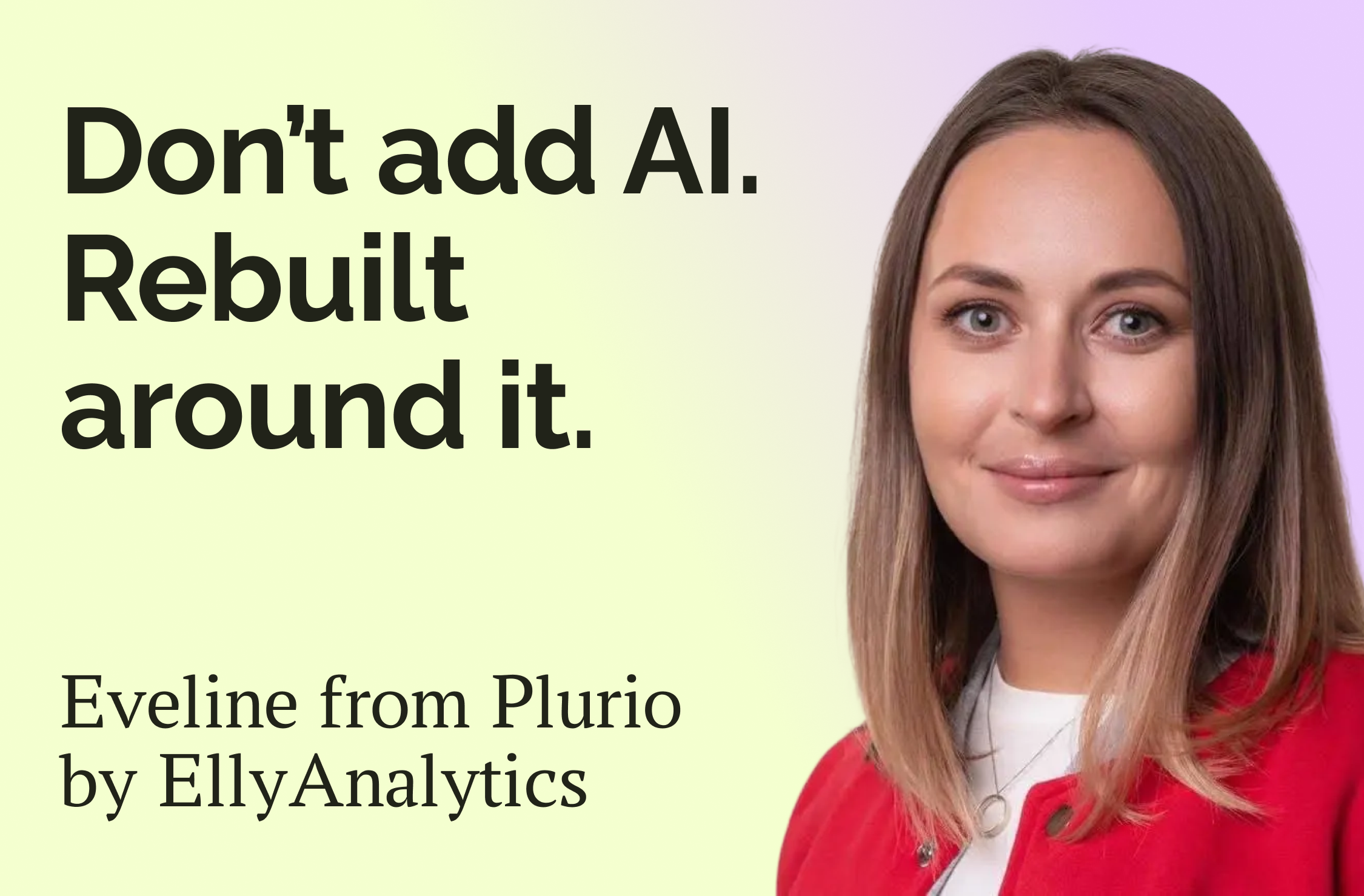
Elly Analytics: Market, Product, and Constraints
Company: Plurio by Elly Analytics, a B2B SaaS company founded by performance marketers.
Product: AI-native marketing analytics and attribution agent. Initially, dashboards and custom analytics; now an autonomous agent that interprets data and acts on ad platforms.
Market: Consumer brands in different industries—healthcare, real estate, subscriptions, and automotive. Transitioned from local market success to the US.
Marketing Team: One in-house marketer (Eveline), supported by external outreach experts. No dedicated growth team. Currently expanded to include a dedicated content team, partner community builders, and an internal AI agent that supports onboarding, research, and execution.
Entering the US Market With Zero Brand and Zero Shortcuts
Elly Analytics faced a worst-case go-to-market scenario: no brand awareness, no local presence, and no partner ecosystem. The US launch required a ground-up build of positioning, messaging, and lead generation.
Partnerships
Initial hypotheses focused on tech integrations and co-marketing. However, traction came unexpectedly from small agencies acting as fractional CMOs. These partners had direct access to client marketing operations and deeply understood the value of attribution tools.
Despite early success, partner sales did not scale without a supporting community. The team paused further investment in this channel until it could be rebuilt with dedicated resources.
Email Outreach, LinkedIn Outreach, Upwork
Three outreach channels were tested using external experts: email automation, LinkedIn messaging, and Upwork-based lead generation. Email proved the most effective. The team shifted from direct demo invitations to interview-style calls, which increased conversion rates and surfaced valuable feedback.
Outreach That Brings 150+ Calls Per Quarter
A scoring system was implemented to qualify prospects based on ad spend, recent hires, and intent signals. SimilarWeb and manual research supported this process.
The funnel was refined with paid interviews. Respondents filled out a quiz with budget, goals, and analytics setup details. Those matching the ideal customer profile (ICP) were invited to a demo. This process generated over 150 calls per quarter with just two account executives.
"We Don’t Want Dashboards. We Want Answers"
The most consistent feedback from US prospects and clients was the desire to skip analysis and receive direct answers. Clients requested not just data, but guidance and actions.
This insight led to a product evolution: from analytics dashboards to a performance marketing AI agent. The AI agent not only interprets marketing data but takes actions in advertising platforms, adjusting bids and budgets in real time.
Cursor as a Company and Marketing OS
Internally, the company transitioned to an AI-first operating model using Cursor. All teams—engineering, analytics, product, and marketing—now work within a shared knowledge base.
Meeting transcripts, strategy documents, and campaign assets are indexed and accessible. Team members query the AI agent instead of searching folders or asking colleagues.
AI in Marketing Execution
Landing Page Creation
A new landing page for the AI agent was developed in a compressed timeframe with substantial input from internal AI tooling. Evelina structured the process by uploading founder vision docs, pilot client transcripts, and competitor analysis into Cursor.
The AI synthesized this material into a structured outline, proposed messaging pillars, and drafted first-page copy. Visual concepts were later added by a designer, but the underlying narrative and CTA logic came from AI-assisted workflows.
This allowed the team to quickly test value proposition variants, review hypotheses, and align product vision with actual use cases discussed by clients.
Marketing Onboarding Fully Automated
Onboarding new marketing hires was historically time-consuming, involving ad hoc knowledge transfer and manual explanation of systems. The team now uses Cursor as a dynamic knowledge base and AI assistant. All documentation, meeting notes, campaign assets, and operational processes are embedded in the platform.
New employees ask the AI directly about positioning, funnel stages, key accounts, campaign logic, and strategic priorities. The system responds with context-rich answers, links to relevant documents, and step-by-step instructions. This significantly reduces onboarding friction and ensures alignment with current processes.
New Human Role
As repetitive tasks and basic research are automated, human marketers shift toward high-leverage functions: framing strategic questions, synthesizing cross-functional insights, and driving experimentation cycles.
The AI executes—preparing documents, summarizing performance, triggering campaign adjustments—while people define objectives, validate learning loops, and make final decisions. This collaboration model enables speed and consistency without sacrificing control.
Lessons for Founders Building Complex B2B Products
- More outreach or new channels do not fix product-market misalignment
- Positioning emerges from conversations, not internal messaging sessions
- AI becomes transformative when empowered to act, not just analyze
- People remain central, but their roles become higher leverage
This article is adapted from a podcast episode where Eveline, Head of Marketing at Plurio by Elly Analytics, openly explains how they approached marketing in a bootstrapped HR tech SaaS, which channels worked, and which ones completely collapsed.
Watch the episode on YouTube or listen on Spotify.
